



Make no mistake: 'Blue Heron' is the most beautiful, most devastating film of the year. It is also, head and shoulders, one of the year's best. It announces the arrival of a major new voice in Canadian writer/director Sophy Romvari, who suggests that while some childhood memories remain untouched, others can never stay buried. Growing up does not mean leaving the past behind; it means learning to understand it differently.
Loosely based on Romvari’s own childhood, 'Blue Heron' follows eight-year-old Sasha (Eylul Guven) and her Hungarian immigrant family as they slowly settle into their new home on Vancouver Island. What begins as a nostalgic portrait of childhood and new beginnings gradually reveals something far more emotionally fraught. We see through Sasha’s eyes as her family struggles to navigate the increasingly troubling behaviour of her older half-brother, Jeremy (Edik Beddoes), his unpredictable presence slowly disrupting the delicate rhythms of their new life. When Jeremy’s behaviour crosses into self-harm, his parents (Iringó Réti, TV’s ‘Halo’ and Ádám Tompa, ‘Tetris’) are left struggling for an answer that they may not even yet have the language to articulate.
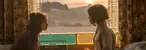
Visually, ‘Blue Heron’ nails the dreamlike nature of childhood summers, the sun-soaked textures of sprinklers, ice cream cones and Microsoft Paint. Cinematographer Maya Bankovic (‘The Invisibles’) is acutely aware that even the most inconsequential details can become some of our most enduring memories. Both Bankovic and Romvari never veer into the fantastical; however, the innocuous sounds and rays of light in suburbia aim to ground Sasha and Jeremy’s world, making it a tangible somewhere that Romvari clearly mourns.
The performances from Romvari’s young cast only strengthen the film's remarkable sense of intimacy and nostalgia. Eylul Guven is the obvious standout, capturing Sasha’s innocence, curiosity and eventual confusion as she simply tries to understand a world that keeps shifting around her. Edik Beddoes is equally as compelling, managing to imbue Jeremy with both an unsettling volatility and tragic helplessness despite only having a handful of scenes and even less lines. Most importantly, Jeremy’s suffering is never conveniently explained away, nor is the family's suffering.
What makes ‘Blue Heron’ so immediately affecting is its empathy and understanding of how children experience the world. Despite what parents believe (and hope) their children won’t pick up on, children really do notice everything, even while understanding little, absorbing these moments all without the tools to process them. Seemingly private adult conversations permeate the next room over, blended with the drone of Saturday cartoons into a confusing cacophony for Sasha and her siblings. Romvari captures this tension beautifully as Sasha maturely attempts to make sense of a scenario that even the adults around her cannot fully comprehend, but what elevates the film beyond your regular family drama is how Romvari explores the relationship between childhood, memory and filmmaking itself.
Without giving too much away, the film gradually complicates its own perspective in the third act, inviting the audience to interrogate the ever-growing distance between the history we carry with us and the stories we build around it for a myriad of purposes. How much of our childhood do we truly remember? How much is simply reconstruction? And what happens, as our views of the world and ourselves change, when the memories we carry begin to shift? Romvari is outstandingly confident in allowing these questions to shape the film's denouement, and she is not interested in pretending as though revisiting the past will provide the answers for Sasha that adulthood tends to promise. Instead, her film accepts the inherent limitations of memory, recognising that there will always be dichotomies between our experiences, what we remember and what we eventually come to understand.
Seemingly private adult conversations permeate the next room over, blended with the drone of Saturday cartoons into a confusing cacophony for Sasha and her siblings. Romvari captures this tension beautifully as Sasha maturely attempts to make sense of a scenario that even the adults around her cannot fully comprehend.
It is also worth noting that, while the film draws from Romvari's own childhood and family history, 'Blue Heron's' achievements extend far beyond the authority of creating art from personal experience. It is no doubt tempting as a director to approach autobiographical filmmaking primarily through the scope of one’s willingness to revisit a painful or emotional past, and for many, taking on such emotional weight once more is an achievement in itself. But with ‘Blue Heron’, Romvari has constructed something that is every bit as special in its creation as it is in its emotional rawness. Her personal history might be the film’s driving vehicle, but it is her curiosity and instincts as a filmmaker that make it extraordinary. Despite having a radically different childhood from Romvari myself, she tells Sasha’s story with such sensitivity and empathy that it was impossible for me not to emotionally latch on, often finding myself in tears.
While ‘Blue Heron’ will no doubt be placed in comparative conversation with ‘Aftersun,’ Charlotte Well’s autobiographical exploration of her father’s mental health, I found myself drawing more connections to Joanna Hogg's masterpiece ‘The Souvenir Part II’. Both films are fascinated by the interplay between personal experience and artistic expression, exploring how the act of filmmaking can offer a cathartic - and often confronting - vehicle for revisiting the past and making sense of events that time, the fallibility of human memory and the weight of emotions have obscured or rendered impossible to reconcile. Neither suggests that art can provide definitive answers or restore an accurate version of one’s history, but there is still value in the process of reflection. One of 'Blue Heron’s' strengths (and one of Romvari’s strengths in general) is the understanding that filmmaking can be both an act of remembrance and a concession to the things that will remain unknowable.
By the time the credits roll, ‘Blue Heron’ feels less like a story with a conclusion and more like a memory unexpectedly re-opened, a picked-at scab from an injury you don’t quite remember sustaining. The film is haunting without melodrama, beautiful without maudlinness - and most importantly, emotionally devastating without ever being manipulative. Romvari deserves immense credit for taking something deeply personal and transforming it into an extraordinary work of cinema, one that knows both the possibilities and limitations of looking backwards.
If this is what Sophy Romvari's filmmaking looks like at the beginning of her career, I am beyond excited for whatever comes next. 'Blue Heron' is a superb debut, a profoundly moving piece of filmmaking and, quite simply, my favourite film of the year.


